WhatsApp vs Email Marketing: Which Wins in 2026?
WhatsApp delivers far higher open and response rates than email, but the two channels aren't interchangeable. Here's how to decide where to invest.
Every marketing budget eventually asks the same question: WhatsApp or email? The honest answer is that they solve different problems — but for anything time-sensitive or conversational, WhatsApp is winning by a wide margin.
The Problem: Inboxes That Don't Get Opened
Email marketing built modern digital commerce, but its core weakness has only gotten worse:
- Open rates sit in the 20-40% range for most industries, and much of what does get opened lands in a Promotions tab, not the primary inbox.
- Emails compete for attention against dozens of other unread messages, often for days before anyone looks.
- There's no real two-way conversation. A reply to a marketing email usually goes nowhere useful.
WhatsApp, running on the official WhatsApp Business Platform, sidesteps all three — it's the app people already check constantly, for personal conversations, so a business message arrives in the same trusted space.
The Great Engagement Divide
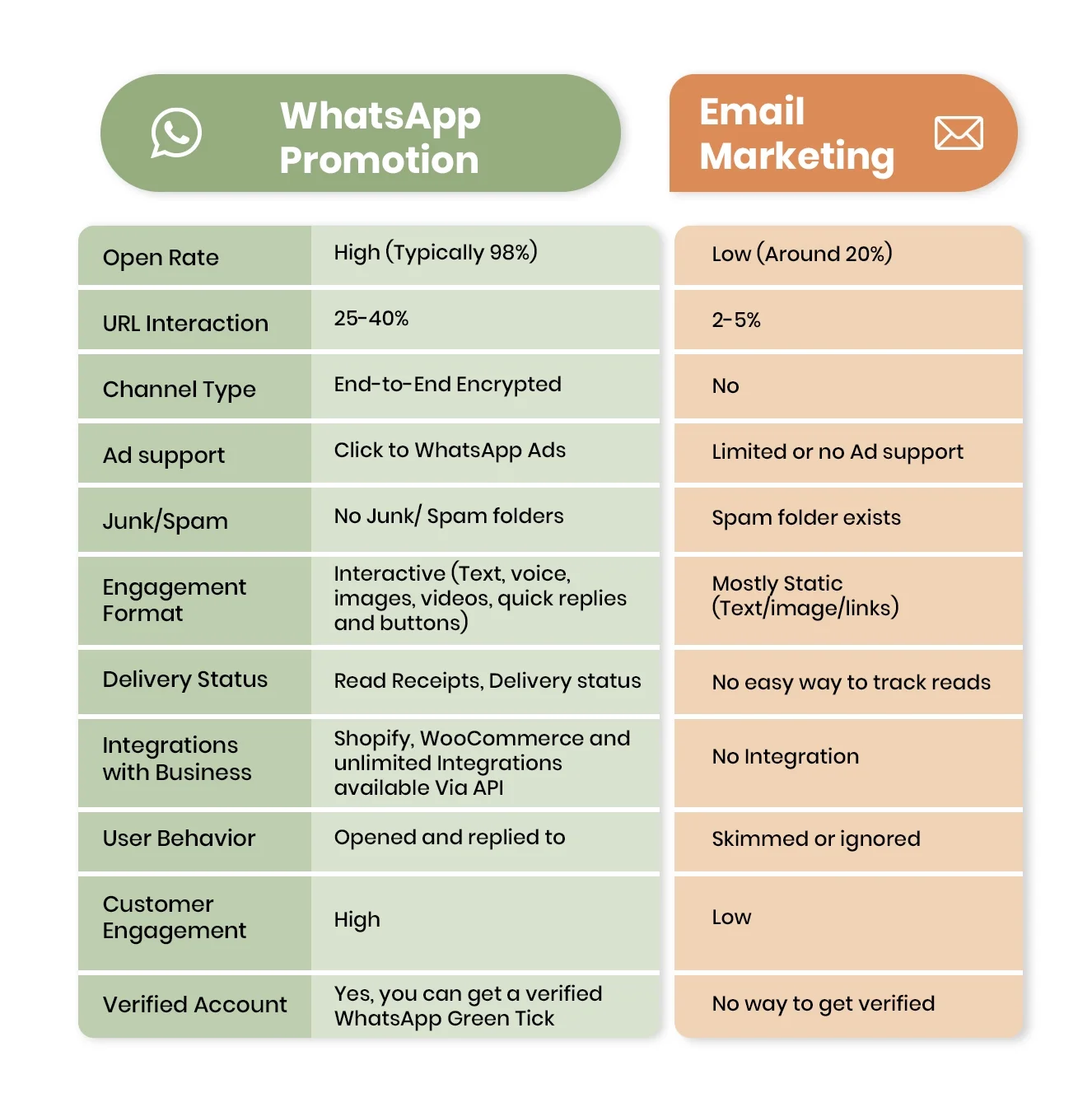
The gap isn't marginal — it shows up in nearly every dimension that determines whether a marketing message actually does its job: does it get seen, and does it get acted on.
Why WhatsApp Performs Differently
Instant, personal context. WhatsApp is the same app people use to talk to friends and family — a business message arrives in a familiar, trusted space rather than a marketing folder.
Mobile-first by design. Unlike email, which still often gets designed and read on desktop, WhatsApp is built entirely around the phone in someone's hand.
Rich, interactive messages. Buttons, images, catalogs, and quick replies let a WhatsApp message do more than a wall of email text — a customer can act without leaving the chat.
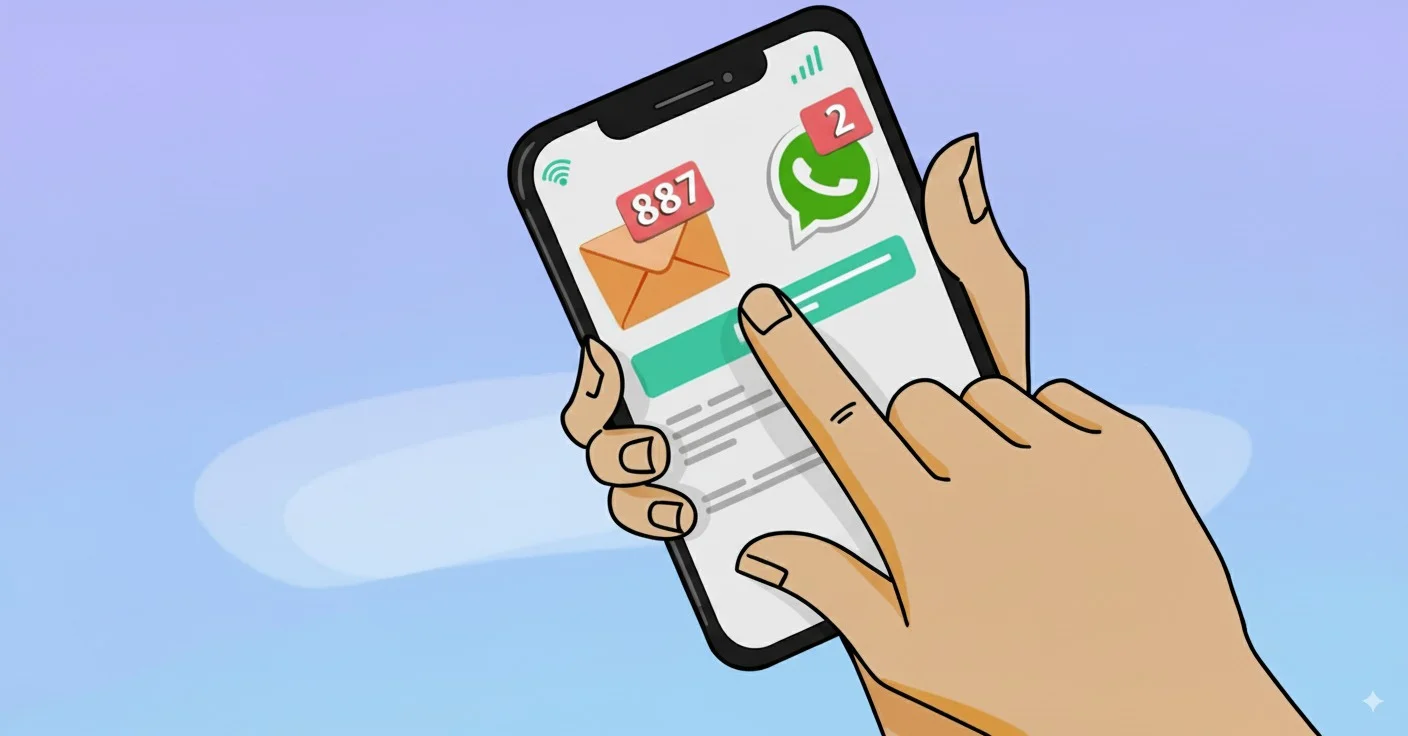
Real two-way conversation. A reply to a WhatsApp message lands in your inbox as an actual conversation your team can act on — not an auto-reply loop.
Where Email Still Wins
Email isn't obsolete. It remains the better channel for:
- Long-form content — newsletters, detailed guides, and anything meant to be read at length rather than skimmed.
- Formal or archival communication — receipts, contracts, and anything a customer might want to search for later.
- Broad top-of-funnel reach, since email addresses are still easier to collect at scale than WhatsApp opt-ins in some contexts.
Building a Combined Strategy
The strongest approach doesn't pick one — it assigns each channel to what it does best:
- Use WhatsApp for anything time-sensitive. Cart recovery, order updates, appointment reminders, flash sales.
- Use email for depth. Onboarding sequences, product education, and content customers want to save.
- Let WhatsApp carry the urgency, and email carry the detail — a WhatsApp message can point to a fuller email or webpage when the topic needs more space than a chat allows.
ROI Snapshot
Illustrative comparison based on typical industry benchmarks — actual results vary by audience and offer.
| Metric | ||
|---|---|---|
| Typical open rate | 20-40% | Very high, usually within minutes |
| Two-way engagement | Limited | Native |
| Rich media support | Static images/links | Images, buttons, catalogs, voice |
| Best suited for | Long-form, archival content | Time-sensitive, conversational messages |
Who This Fits
| Business Type | Best Channel Mix |
|---|---|
| E-commerce & retail | WhatsApp for cart recovery and order updates, email for newsletters |
| Food & delivery | WhatsApp for ordering and delivery tracking |
| Service businesses | WhatsApp for bookings and reminders, email for onboarding |
| Content-heavy brands | Email for long-form, WhatsApp for time-sensitive nudges |
A Non-Obvious Insight
The businesses that get the worst results from WhatsApp marketing are usually the ones that copy-pasted their email strategy onto it — long promotional blasts, sent at email frequency, with email-style subject-line tricks. WhatsApp punishes that approach quickly: a number that starts to feel like a marketing list gets muted or blocked, and WhatsApp itself tracks block rates against your account's messaging quality. The channels aren't interchangeable strategies wearing different outfits — they reward genuinely different behavior, and treating WhatsApp like a faster email list is the fastest way to waste its advantage.
Why ChatSyncs?
- Official WhatsApp API — a verified number, no ban risk, unlike unofficial bulk tools.
- Built for conversation, not just broadcast — replies land in a shared inbox your team can act on.
- No-code setup — launch WhatsApp campaigns without a developer.
- Grows with you — start self-serve on Starter, or get guided or done-for-you setup as you scale.
Final Step
The question was never really "WhatsApp or email" — it's which channel fits which message. Use WhatsApp where speed and conversation matter, and email where depth does. If you're ready to add WhatsApp to your mix, start with a broadcast campaign or a no-code chatbot flow — ChatSyncs handles both from the same dashboard.
Sources & further reading

Lakshit Ukani
Founder, ChatSyncs
I help growing businesses respond instantly, follow up automatically, and close more sales on WhatsApp — using the official WhatsApp Business API.